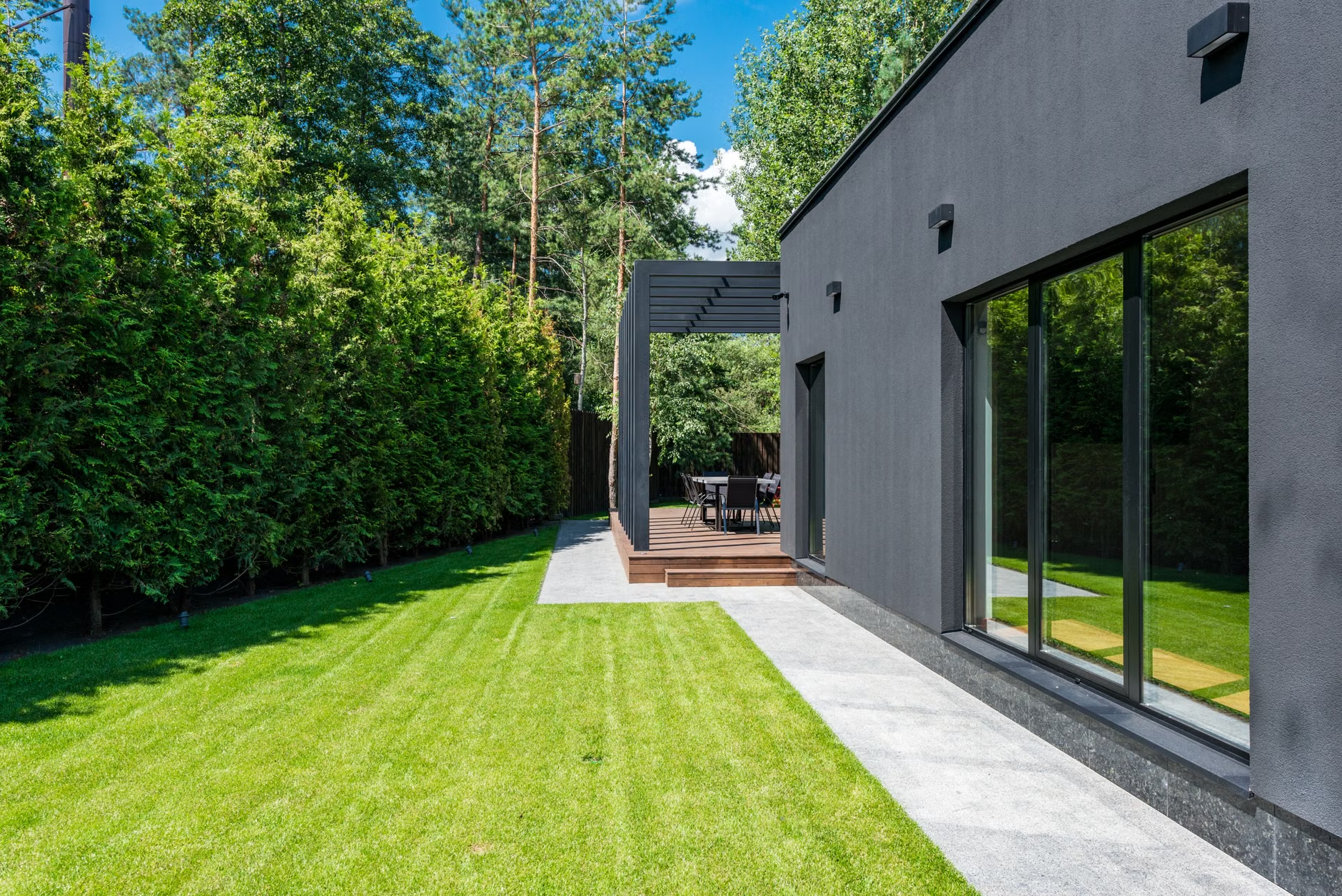
A fence is the obvious answer to backyard privacy, but it is not the only one, and often not the smartest one. Many privacy problems are not really about the property line at all. They come from a second-story window, a patio that sits lower than the neighbor’s deck, a gap beside the grill area, or a straight sightline from the street to the seating area.

That matters because the best no-fence solution is usually targeted, layered, and mixed. A narrow trellis can solve a side-angle problem faster than a hedge. A pergola with curtains can block upper-level views better than a row of shrubs. Containers can create privacy in a week, while a mixed evergreen screen can create better long-term cover if there is room to let it grow. The goal is not to build a substitute fence everywhere. It is to block the views that actually make the yard feel exposed.

TL;DR

  • Start by mapping the sightlines into the yard. Side views, elevated views, and street views usually need different fixes.
  • Evergreen and mixed-species planting gives the most natural long-term privacy, while containers, panels, and fabric structures give the fastest results. Evergreens provide year-round screening, and diverse plantings are more resilient than a single-species row. (extension.oregonstate.edu)
  • Vines on trellises or arbors are especially useful in tight spaces because they add height without taking much ground area. (hgic.clemson.edu)
  • Plants help with visual privacy far more reliably than with major noise reduction unless the planting is tall, wide, and dense. (yardandgarden.extension.iastate.edu)
  • Before installing pergolas, shade sails, tall panels, or similar structures, check local setback, zoning, permit, and HOA rules. Even relatively small structures may still trigger review depending on location and use. (sandiego.gov)

Privacy gets easier when you map the view before you buy anything

A simple sightline map is the most useful planning tool for this kind of project. It is not a formal design document. It is just a deliberate way to figure out where the privacy problem really starts. Stand or sit where the yard is actually used: at the dining table, in the lounge chair, beside the hot tub, near the play area, or at the kitchen window looking out. Then mark where eyes can reach that spot from neighboring yards, windows, decks, sidewalks, or alleys.

  1. Mark the source of the view: next door at ground level, from above, or from the street.
  2. Decide whether you need seated privacy, standing privacy, or overhead privacy. These are not the same height requirement.
  3. Note whether winter privacy matters. Deciduous screening can look full in July and transparent in January. Evergreens keep year-round cover. (extension.oregonstate.edu)
  4. Measure the footprint available. A layered planting may need real depth, while a trellis or panel can fit into a narrow side yard.
  5. Check water, drainage, and maintenance realities before choosing plants or containers.
  6. Verify local rules if the solution includes posts, overhead framing, sails, walls, or fixed panels. Municipal requirements vary. (sandiego.gov)
Tip

Example: if the real problem is an upstairs neighbor looking down onto a patio, a low hedge along the property line may do almost nothing. A pergola, small canopy tree, or side-mounted curtain can solve the actual sightline faster.

The most useful no-fence privacy ideas, compared

This comparison is editorial guidance meant to help match each idea to the kind of privacy problem it solves best.
Idea Best for Privacy speed Space needed Upkeep Main tradeoff
Layered shrub and small-tree border Property-line screening that should look natural Slow to medium Medium to deep Medium Takes time and pruning discipline
Mixed evergreen screen Year-round cover between neighboring yards Medium Medium Medium Can feel heavy if planted too close or too uniformly
Trellis or arbor with vines Narrow spaces and patio-edge screening Medium Shallow Medium Needs strong support and plant control
Pergola with curtains or slats Patio seating areas and elevated sightlines Fast Medium Medium to high Structure, fabric, and local rules all matter
Shade sail with planting below Sun plus diagonal privacy near patios or pools Fast Small to medium Medium Not a full-season or full-boundary solution
Large containers with shrubs or grasses Renters, hardscape patios, and flexible layouts Fast Small to medium High Frequent watering and limited root space
Freestanding decorative panels Instant privacy at one exact angle Fast Shallow Low to medium Can look abrupt unless softened with plants

Most successful backyards use two speeds at once: one element that works immediately, and one that improves over time. That usually means pairing a fast screen, such as panels, curtains, or containers, with a slower living screen that will eventually do more of the work.

Living screens work best when they act like landscape, not like a green wall

Planting is often the strongest long-term option because it can create privacy without making the yard feel boxed in. But a good screen is not just a row of identical shrubs pushed close together. Oregon State Extension recommends thinking about mature height, evergreen versus deciduous habit, water needs, drainage, light, and maintenance before choosing screening plants. It also notes that a diverse mix of species helps protect against loss from a single pest or disease. (extension.oregonstate.edu)

A backyard patio screened by layered shrubs, small trees, and ornamental grasses
A layered planting provides privacy without making the yard feel like a hard boundary. Credit: Photo by Max Vakhtbovych on Pexels. Source: Pexels.

Why mixed screens usually outperform a one-species hedge

A mixed screen tends to age better, look softer, and fill visual gaps more effectively. An evergreen backbone can provide winter cover, while deciduous shrubs, small trees, or ornamental grasses create seasonal texture and help break up the rigid look of a single hedge. Clemson Extension specifically warns that the old one-row monoculture model can become unreliable over time, while mixed screens provide privacy with more biodiversity and visual interest. (hgic.clemson.edu)

If there is space, a staggered arrangement is often better than a straight line. The rear layer handles height, the middle layer fills eye level, and the front layer hides bare stems and makes the screen look intentional. This is especially useful when privacy matters from a seated area, because many shrubs do not stay full to the ground unless they are selected and pruned for that job.

How to keep hedges from becoming bare at the bottom

One of the most common privacy mistakes is letting a hedge become top-heavy. Clemson Extension advises starting pruning while hedge plants are young to encourage branching, and it specifically recommends keeping formal hedges wider at the base than at the top. Otherwise the upper growth shades the lower growth, and the screen thins out exactly where privacy is needed most. The same source also notes that some narrow-leaf evergreens, including many conifers, do not respond well to severe pruning. (hgic.clemson.edu)

It is also worth being realistic about sound. A planted screen can help a yard feel calmer, and dense planting can reduce some noise, but Iowa State Extension says effectiveness depends on height, width, and density, and that strong reduction usually requires a deep planting belt rather than a thin ornamental row. In other words, shrubs are much better at hiding people than replacing a true sound barrier. (yardandgarden.extension.iastate.edu)

When space is tight, vertical privacy is often the smartest answer

Trellises, arbors, and freestanding slatted panels solve a very specific problem well: not enough depth for a broad planting bed. Clemson Extension notes that vines are useful in tight spaces and can be used on trellises or arbors to create privacy and hide unattractive areas. That makes them especially helpful beside patios, along narrow side yards, or in townhouse backyards where every foot of usable ground matters. (hgic.clemson.edu)

The important decision is not just the plant. It is the combination of plant, support, and maintenance. A light annual vine on a simple trellis is one thing. A vigorous woody vine on a freestanding arbor is another. Clemson also notes that vigorous vines may compromise the health of a tree if allowed to climb it, which is a good reminder not to use existing trees as casual support posts. (hgic.clemson.edu)

Be cautious with species selection. The National Invasive Species Information Center notes that whether a plant is invasive depends partly on local conditions and that invasiveness has to be evaluated by place, not by a one-size-fits-all national rule. That is a strong reason to use local Extension guidance before planting fast-spreading vines or running species near fences, woods, or natural areas. (invasivespeciesinfo.gov)

A slim trellis covered with vines beside a small patio seating area
Vertical screening is especially useful when the yard does not have room for a deep planting bed. Credit: Photo by hi room on Pexels. Source: Pexels.

Pergolas, shade sails, and outdoor curtains are best for patio privacy, not boundary privacy

These options work best when the exposed space is a destination zone, not the entire yard. If the problem is that the dining area feels watched, or a hot tub sits under neighboring windows, a room-like structure can work better than a long planting bed. Pergolas create overhead presence, curtains block side views at human height, and shade sails help with diagonal sightlines while also reducing sun exposure.

The main caution is that homeowners often treat these as simple décor when local rules may treat them as structures. The City of San Diego says some patio covers under 300 square feet may be exempt from a building permit, but setbacks, sensitive sites, and other conditions can still require review. The City of Tucson says small shade sails may not require a permit in some cases, but size, use, zoning context, and special districts still matter. Those examples are not national rules. They are proof that local requirements vary enough that checking first is worth the effort. (sandiego.gov)

Warning

If the yard is in a wildfire-prone area, do not crowd the house with dense screening or highly combustible materials just to create privacy. Colorado State University Extension advises keeping the first 5 feet near structures dominated by nonflammable materials and limiting foundation plantings in that zone. (pueblo.extension.colostate.edu)

Even where permits are not required, outdoor fabrics and light structures have real maintenance demands. Wind loads stress posts and hardware. Curtains collect moisture and dirt. Cheap fabric fades quickly. A pergola or sail can be excellent as part of a privacy strategy, but it is usually better as a focused zone solution than as the only plan for the whole yard.

A backyard pergola with side curtains around an outdoor dining space
Pergolas and curtains work best when the goal is to create privacy around one destination zone. Credit: Photo by Max Vakhtbovych on Pexels. Source: Pexels.

Container screens are flexible and fast, but they are not low-maintenance

Large containers can create privacy faster than almost anything else. They are especially useful on patios, around pools, on decks, and in rental-friendly situations where digging is limited. A row of substantial planters with evergreen shrubs, narrow small trees, or tall grasses can redirect views almost immediately and can be rearranged later if the layout changes.

The tradeoff is water. Iowa State Extension says containers need much more frequent watering than garden beds, and in summer they should be checked daily. It also advises watering until water drains from the bottom rather than giving quick, shallow drinks. That is why the best container privacy setups usually rely on fewer, larger planters and some form of drip or micro-irrigation, not a scattered collection of undersized pots. (yardandgarden.extension.iastate.edu)

Containers also need honest thinking about root room, weight, drainage, and winter exposure. Woody plants can be grown in containers with care, but they are less forgiving there than they are in the ground. If the goal is a permanent low-effort privacy screen, containers are usually a bridge solution or a patio-specific solution, not the easiest long-term answer. (ucanr.edu)

Large planters with evergreen shrubs arranged to screen a backyard patio
Container screens create privacy quickly but usually need more frequent watering and maintenance. Credit: Photo by Kévin et Laurianne Langlais on Pexels. Source: Pexels.

What usually goes wrong with backyard privacy projects

  • Solving the wrong problem. A side-yard hedge will not fix a view from an upper story.
  • Buying for current size instead of mature size. Screening plants need room to become dense, not just tall. Oregon State Extension recommends selecting with mature height and site conditions in mind. (extension.oregonstate.edu)
  • Using a single species everywhere. Mixed screens are often more resilient and visually better than monocultures. (hgic.clemson.edu)
  • Pruning late and harshly. Some privacy shrubs respond well to training, but many conifer-type evergreens do not recover well from severe cuts. (hgic.clemson.edu)
  • Expecting plants to behave like an acoustic wall. For serious traffic noise, narrow ornamental planting has limited effect. (yardandgarden.extension.iastate.edu)
  • Ignoring irrigation. Container screens and new plantings fail more often from care gaps than from bad aesthetics. New hedgerow-style plantings often need supplemental water for the first years. (extension.oregonstate.edu)
  • Placing dense screens too close to the house in fire-prone areas. Defensible-space guidance may change what is appropriate near structures. (pueblo.extension.colostate.edu)
  • Skipping permit, setback, or HOA review because the project does not feel like a building project. In some jurisdictions, it still is. (sandiego.gov)

A practical action plan for the next weekend

  1. Take photos from the places where privacy matters most, while sitting and standing.
  2. Mark proposed screen lines with stakes, painter’s tape, or lightweight poles so you can judge height before buying materials or plants.
  3. Choose one immediate solution and one long-term solution. Example: curtains now, mixed evergreen planting later; or containers now, in-ground screen next season.
  4. Check the site conditions honestly: sun, drainage, irrigation access, and winter exposure. Match plants to those conditions rather than to a photo.
  5. If using a living screen, prepare the planting area first and plan for irrigation during establishment. Supplemental watering is especially important during the first years. (extension.oregonstate.edu)
  6. If using structures, verify local rules and setbacks before ordering posts, sails, or pergola kits. (sandiego.gov)
  7. Live with the mock-up for a few days. Privacy mistakes are much cheaper to correct with stakes than with installed posts or oversized shrubs.

The strongest no-fence privacy yards usually feel designed rather than defended. They block only the views that matter, keep the yard usable, and combine quick fixes with slower elements that age well. If there is one decision rule to remember, it is this: solve the sightline first, then choose the material. That one shift leads to better-looking, more effective privacy almost every time.

FAQ

What is the lowest-cost backyard privacy idea without a fence?

The lowest entry-cost option is often a simple trellis or freestanding panel paired with fast-growing seasonal vines, because it solves one view directly without requiring a full landscape project. The catch is that annual vines are seasonal, and lightweight panels do not provide the permanence of a planted screen.

How do I block second-story neighbors without making the whole yard dark?

Focus on the zone where privacy matters most instead of trying to wall off the entire yard. Pergolas, partial overhead structures, small canopy trees, or side curtains near seating areas usually work better for downward views than a tall hedge stretched across the whole property.

Do privacy plants actually reduce noise?

Sometimes, but expectations need to stay realistic. Iowa State Extension says noise reduction depends mainly on the planting’s height, width, density, and placement. Deep, dense plantings can help, but a thin decorative row is mostly a visual screen rather than a serious sound barrier. (yardandgarden.extension.iastate.edu)

Are pergolas and shade sails usually permit-free?

Not necessarily. Rules vary by city and by the details of the project. Official city guidance from San Diego and Tucson shows that size, setbacks, special districts, and whether the structure is treated as occupiable space can all affect permit status or review requirements. (sandiego.gov)

What is the lowest-maintenance option for long-term privacy?

A well-sited mixed evergreen screen is usually lower-maintenance over time than fabric-heavy or container-heavy solutions, but only if the plants are selected for the site, spaced for mature size, and pruned correctly while young. Containers and curtains look fast and easy at first, but they usually demand more ongoing care. (extension.oregonstate.edu)

References

  1. Oregon State University Extension – A Guide to Hedgerows: Plantings That Enhance Biodiversity, Sustainability and Customhttps://extension.oregonstate.edu/catalog/em-8721-guide-hedgerows-plantings-enhance-biodiversity-sustainability-functionality
  2. Clemson Home & Garden Information Center – Pruning Shrubshttps://hgic.clemson.edu/factsheet/pruning-shrubs/
  3. Clemson Home & Garden Information Center – Vine Selections for Landscapinghttps://hgic.clemson.edu/factsheet/vine-selections-for-landscaping/
  4. Clemson Home & Garden Information Center – Mixed Screenshttps://hgic.clemson.edu/factsheet/mixed-screens/
  5. Iowa State University Extension – Care of Plants Growing in Containershttps://yardandgarden.extension.iastate.edu/how-to/care-plants-growing-containers
  6. Iowa State University Extension – Using Trees and Shrubs to Reduce Noise Around Homeshttps://yardandgarden.extension.iastate.edu/how-to/using-trees-and-shrubs-reduce-noise-around-homes
  7. USDA National Invasive Species Information Center – Terrestrial Plantshttps://www.invasivespeciesinfo.gov/terrestrial/plants
  8. City of San Diego – Patio Covershttps://www.sandiego.gov/development-services/forms-publications/information-bulletins/206
  9. City of Tucson – Do I Need a Permit? (Exemptions)https://www.tucsonaz.gov/Departments/Planning-Development-Services/Permits/Tucson-Permit-Exemptions
  10. Colorado State University Extension – Landscaping in the Wildland-Urban Interfacehttps://pueblo.extension.colostate.edu/landscaping-in-the-wildland-urban-interface/